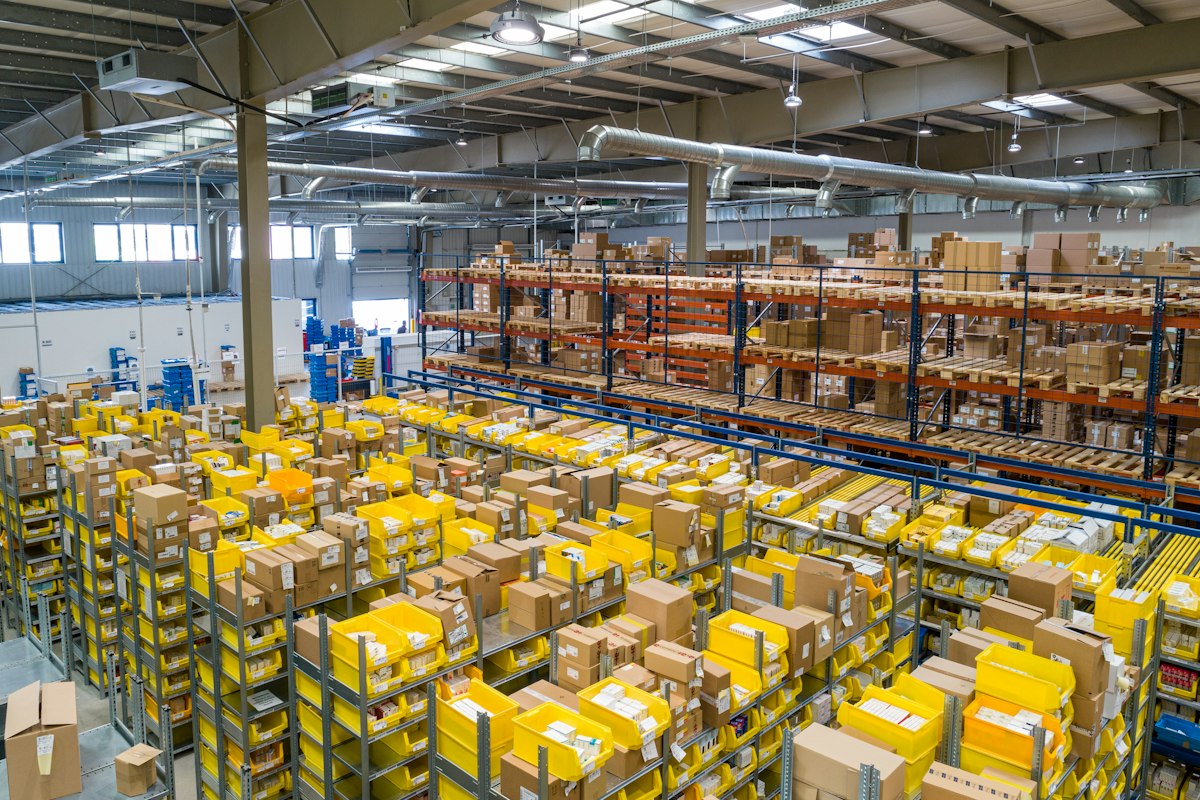
The challenge
Your warehouse runs. But it takes effort. Forklift operators are scarce and expensive. Peak periods keep you up at night. Picking errors cost money and customers. And nights or weekends? Everything sits idle.
Traditional automation — think fixed conveyors and rails — requires massive investments and offers little flexibility. Change your product mix? Too bad. Need to scale for Black Friday? Good luck.
Meanwhile, customers expect ever-faster deliveries. Amazon raised the bar, and everyone feels the pressure.
The solution: AI that learns and adapts
Modern industrial AI combines computer vision, machine learning, and robotics into systems that operate truly autonomously. No programmed routes — intelligence that adapts to reality.
What this means in practice:
- Autonomous forklifts that independently retrieve pallets from racks and load them into trucks — no human intervention needed
- Smart replenishment that automatically restocks pick locations overnight based on tomorrow's orders
- Flexible picking robots that recognize different products and collect them without errors
- Dynamic route planning that calculates optimal paths in real-time, even when something's in the way
Example: The autonomous forklift
Picture this: a forklift navigating your warehouse without a driver. It knows exactly where every pallet is, calculates the optimal route, and loads trucks with millimeter precision. No breaks, no fatigue, no rushing errors.
How does it work?
- Perception: Cameras and LiDAR continuously scan the environment — racks, other vehicles, people, obstacles
- Localization: The system always knows exactly where it is, accurate to the centimeter
- Planning: AI calculates the best route, accounting for other activities and priorities
- Execution: Precise control for picking up, moving, and placing loads
- Safety: Multiple failsafes — when uncertain, the system always stops
This isn't a prototype. This runs in warehouses worldwide.
Where else AI excels in industry
- Quality control: Cameras that spot defects human eyes miss — faster and more consistently
- Predictive maintenance: Machines that signal when they need maintenance, before they break down
- Dock scheduling: AI that optimally distributes incoming trucks across loading docks
- Inventory optimization: Predicting what you need, where it should be stored, and when to reorder
- Energy optimization: Smart control of lighting, climate, and machinery based on actual usage
The numbers
- 24/7 operation — no shift work, no weekend premiums
- 40-60% higher throughput in automated zones
- 99%+ picking accuracy — fewer returns, happier customers
- Dramatically fewer accidents — AI doesn't make rushing mistakes
- Flexibly scalable — add capacity without renovations
Our approach
We start small and prove value before scaling. No theoretical studies — working systems.
- Assessment: We analyze your current operation, identify bottlenecks and opportunities
- Pilot design: Together we choose one defined zone or process for initial implementation
- Implementation: We build, test, and fine-tune until the system runs reliably
- Scale-up: After proven success, we expand to other zones and processes
The pilot typically takes 8-12 weeks. After that, you'll know exactly what AI can do for your operation — with real data, not slides.
Frequently asked questions
How safe are autonomous forklifts?
Safer than you might think. AI-driven vehicles don't suffer from fatigue, distraction, or rushing. They combine LiDAR, cameras, and sensors for 360° awareness. When uncertain, they stop — always. Most warehouse accidents stem from human errors that AI simply doesn't make.
What if my warehouse layout isn't standard?
That's exactly where AI excels. While traditional automation requires fixed routes and perfect conditions, AI learns to adapt. Narrow aisles, changing rack configurations, unexpected obstacles — the system handles it like an experienced worker would, but more consistently.
Will this replace all my warehouse staff?
That's not the goal. AI takes over the heavy, repetitive, and dangerous work. Your people get more valuable tasks: quality control, problem-solving, customer interaction. In practice, we see companies grow without proportionally needing more staff — not laying people off.
How long does implementation take?
A pilot in one zone of your warehouse can be running within 8-12 weeks. Full rollout depends on scale and complexity, but we always work in phases: first prove it works, then scale up. No big bang implementations.
Curious what this could mean for your operation?
We'd love to visit and explore the possibilities. No sales pitch — just an honest conversation about what can and can't work.
Schedule a conversation